IGNOU Grievance 2026: Students enrolled at Indira Gandhi National Open University (IGNOU) may sometimes face problems related to admission, assignments, examinations, results, grade cards, study centres, regional centres, fees, study material, certificates, or other academic services. When a student is unable to resolve an issue through the regular process, the IGNOU Grievance portal provides an online platform for submitting and tracking complaints.
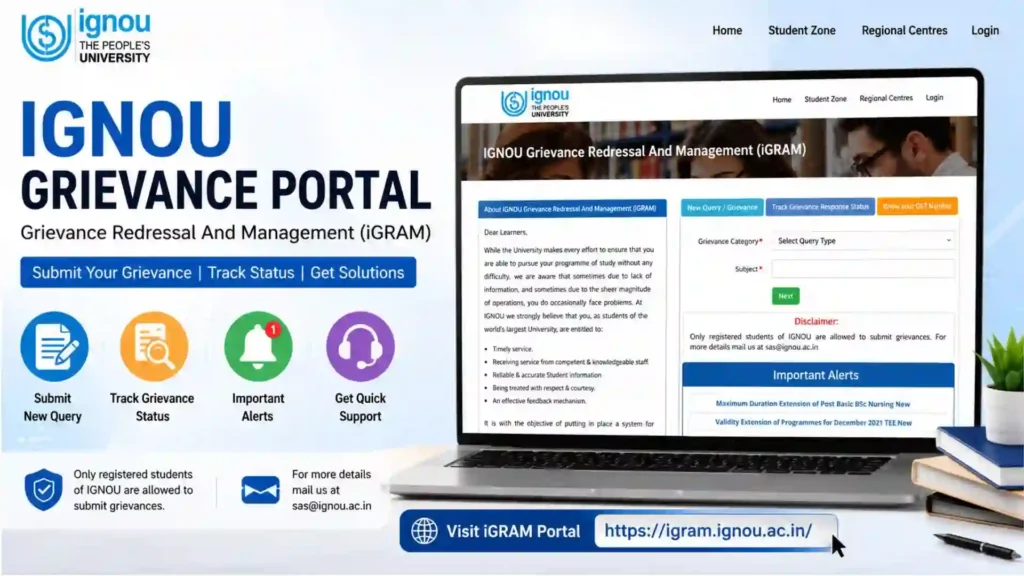
The grievance system is useful because students do not always need to visit an IGNOU Regional Centre or Study Centre personally to raise an issue. By submitting a complaint online, students can provide details of their problem and keep track of its progress.
This guide explains how to use the IGNOU grievance portal, what types of complaints students can submit, what information should be included in a grievance, how to track a complaint, and what to do if the issue is not resolved.
What is IGNOU Grievance?
An IGNOU grievance is a complaint or concern raised by a student regarding an issue related to the university’s academic, administrative, examination, admission, or student-support services.
IGNOU has a large number of students across different programmes, Regional Centres, and Study Centres. Because of this, students may occasionally experience delays or discrepancies in university services.
Examples of common student concerns include:
- Admission-related problems
- Enrollment issues
- Assignment submission problems
- Assignment marks not updated
- Grade card discrepancies
- Examination-related issues
- Result-related concerns
- Practical examination issues
- Project evaluation delays
- Study material problems
- Fee-related concerns
- Regional Centre issues
- Study Centre-related complaints
- Correction of student information
- Other academic or administrative problems
The grievance portal provides a centralized way for students to communicate such concerns.
Important Links and Information
| Particular | Details |
|---|---|
| Service | IGNOU Grievance |
| University | Indira Gandhi National Open University |
| Purpose | Submit and track student grievances |
| Grievance Portal | https://igram.ignou.ac.in/ |
| Mode | Online |
| Users | IGNOU Students |
| Common Issues | Admission, Assignment, Exam, Result, Grade Card, Study Centre and other student services |
| Information Required | Student and complaint-related details |
| Recommended Action | Provide accurate details and supporting information |
| Tracking | Use the grievance portal to monitor the complaint |
Why is the IGNOU Grievance Portal Important?
The grievance portal is important because students may sometimes encounter problems that cannot be resolved through routine online services.
For example, a student may have submitted an assignment but find that the marks have not appeared in the grade card. Another student may have an issue with admission confirmation, examination records, or programme-related information.
Instead of repeatedly contacting different departments without a record of the complaint, students can use the grievance system to formally communicate their concern.
A properly submitted grievance can help bring the issue to the attention of the appropriate authority.
How to Access the IGNOU Grievance Portal?
Students can access the portal using the official grievance website.
Step 1: Open the Grievance Portal
Visit:
Step 2: Review the Available Options
Once the portal opens, carefully check the available options for registering or managing a grievance.
Step 3: Enter Your Details
Provide the student information requested by the portal.
Make sure that the information is entered correctly because incorrect details can make it difficult to identify your student record.
Step 4: Describe Your Problem
Explain the issue clearly and briefly.
For example, instead of writing:
“My marks are missing.”
provide useful information such as the relevant course, examination session, assignment submission details, and the specific issue you are experiencing.
Step 5: Submit the Grievance
After checking all the information, submit your complaint through the portal.
Keep any complaint or reference number generated by the system for future tracking.
What Types of Complaints Can Students Submit?
The IGNOU grievance system can be useful for a wide range of student-related issues.
Admission Grievance
Students may raise concerns about admission processing, enrollment, programme details, or other admission-related issues.
Before submitting a grievance, students should verify that their application and payment details are correct.
Assignment Grievance
Assignments are an important part of IGNOU’s academic evaluation. Students may face problems such as:
- Assignment marks not appearing.
- Assignment submission not reflected.
- Incorrect assignment information.
- Evaluation-related concerns.
Students should keep their assignment submission receipt or acknowledgement available when raising such a complaint.
Grade Card Grievance
If a student’s grade card does not display expected marks, the student may need to raise a concern.
For example, assignment, theory, practical, or project marks may be missing or may not have been updated.
Students should first check whether the relevant evaluation process has been completed before submitting a grievance.
Examination Grievance
Students may also have concerns related to Term-End Examinations.
Examples include:
- Examination-related records.
- Examination centre concerns.
- Theory examination issues.
- Practical examination issues.
- Examination result discrepancies.
The exact process for resolving an examination issue may depend on the nature of the complaint.
Result Grievance
A student may submit a grievance when there is a concern regarding examination results or related academic records.
Before submitting the complaint, students should compare the available result information with their grade card and other academic records.
Project Grievance
Students enrolled in programmes requiring project work may encounter issues related to project submission or evaluation.
Keeping project submission proof and relevant communication can be useful when raising a complaint.
What Information Should You Include in an IGNOU Grievance?
A good grievance should be clear, specific, and supported by relevant information.
Students should include details such as:
- Full name
- Enrollment Number
- Programme Code
- Regional Centre, where relevant
- Study Centre, where relevant
- Course Code
- Examination session, if applicable
- Assignment submission details, if applicable
- Project details, if applicable
- Description of the problem
- Date or relevant timeline
- Supporting documents, where applicable
Providing complete information can make it easier for the concerned authority to understand the issue.
How to Write a Good IGNOU Complaint?
When submitting an IGNOU grievance, avoid writing a very short or unclear complaint.
For example:
Poor complaint:
“My grade card is wrong. Please fix it.”
A better complaint would explain the exact problem:
“I submitted the assignment for the relevant course before the prescribed deadline, but the assignment marks are not appearing in my grade card. I have retained the assignment submission acknowledgement. Kindly verify the submission record and update the marks if applicable.”
The second version provides more useful information and makes it easier to understand the issue.
Documents You Should Keep Ready
Depending on your complaint, you may need supporting documents.
These may include:
- Assignment submission receipt
- Admission fee receipt
- Examination form receipt
- Application confirmation
- Enrollment details
- Grade card
- Result details
- Project submission proof
- Relevant screenshots
- Previous correspondence with IGNOU
Do not upload unnecessary documents. Provide only relevant information requested by the grievance system.
How to Track an IGNOU Grievance?
After submitting a grievance, students should keep the complaint or reference details safely.
The grievance portal can be used to monitor the complaint according to the options available on the website.
Students should avoid submitting multiple identical complaints for the same issue unless instructed to do so. Multiple submissions may make it harder to track the original complaint.
Instead, keep your reference information and check for updates.
What to Do If Your Grievance Is Not Resolved?
Sometimes a complaint may take time to resolve, particularly when the issue requires verification from a Study Centre, Regional Centre, examination department, or another authority.
If your grievance remains unresolved:
- Check the complaint status.
- Verify that your submitted information is correct.
- Keep your grievance reference details ready.
- Check whether additional information has been requested.
- Follow up through the appropriate IGNOU channel.
- Contact the relevant Regional Centre or Study Centre where appropriate.
Students should remain patient while allowing the concerned department sufficient time to investigate the issue.
Common Mistakes to Avoid
Students should avoid the following mistakes when submitting a grievance:
- Entering an incorrect Enrollment Number.
- Selecting the wrong programme.
- Providing incomplete information.
- Submitting an unclear complaint.
- Uploading unrelated documents.
- Submitting multiple identical grievances.
- Losing the complaint reference number.
- Failing to check for status updates.
A clear and properly documented complaint is more useful than a repeated complaint containing incomplete information.
Tips for Resolving IGNOU Issues Faster
Although processing time can vary depending on the nature of the issue, students can make the process easier by providing complete information from the beginning.
Keep all important academic documents organized in one place. Save receipts after submitting assignments, examination forms, admission applications, and projects.
Also, take screenshots of important online records when necessary. These records can help establish what information was displayed when the problem occurred.
Most importantly, clearly explain what has happened and what resolution you are requesting.
When Should You Submit an IGNOU Grievance?
Students should generally raise a grievance when they have a genuine issue that requires intervention and cannot be resolved through the normal process.
For example, if an assignment was recently submitted and the marks are not yet visible, it may be appropriate to wait for the normal evaluation and updating period before submitting a complaint.
On the other hand, if there is a significant discrepancy or a problem remains unresolved after the relevant process has been completed, submitting a grievance may be appropriate.
FAQ about IGNOU Grievance Portal 2026
What is the IGNOU grievance portal?
The IGNOU grievance portal is an online platform through which students can submit and track complaints related to academic and administrative services.
Where can I submit an IGNOU grievance?
You can access the IGNOU grievance portal here:
IGNOU Grievance Portal
What problems can I report through an IGNOU grievance?
Students can raise concerns related to admission, assignments, examinations, results, grade cards, projects, study centres, regional centres, and other university-related services.
What details should I provide in my grievance?
Provide accurate student details and clearly explain the problem. Depending on the issue, you may also need to provide course information, examination details, assignment information, or supporting documents.
Should I keep proof after submitting a grievance?
Yes. Students should save the complaint or reference number and any confirmation received after submitting the grievance.
Can I submit a grievance about missing assignment marks?
Yes, if you have a genuine concern about assignment marks not being updated after the relevant evaluation process. Keep your assignment submission proof available.
What should I do if my grievance is not resolved?
Check the grievance status and follow up through the appropriate IGNOU channel. You may also contact the relevant Study Centre or Regional Centre depending on the nature of the issue.
Should I submit multiple grievances for the same problem?
Generally, students should avoid submitting duplicate complaints for the same issue. Keep the original reference number and follow up using the available tracking mechanism.
Is the IGNOU grievance portal useful for admission problems?
Yes. Students with genuine admission-related concerns can use the grievance system to communicate their issue and provide relevant admission information.
Is it necessary to attach documents with every grievance?
Not necessarily. The documents required depend on the nature of the complaint and the instructions provided by the portal. Provide relevant supporting documents when requested or when they are necessary to explain your case.
Conclusion
The IGNOU grievance portal is an important facility for students who face problems related to admission, assignments, examinations, results, grade cards, projects, study centres, and other university services. Instead of repeatedly trying to resolve a problem without a formal record, students can use the online grievance system to communicate their concerns in a structured manner.
When submitting a grievance, always provide accurate details, clearly explain the issue, and keep relevant documents such as receipts, screenshots, and academic records available. After submission, save the grievance reference details and monitor the status regularly.
Students can access the IGNOU grievance portal here: Check IGNOU Grievance Status / Submit a Grievance
A clear complaint containing the correct Enrollment Number, programme information, course details, and supporting evidence can make it easier for the concerned department to understand and address the issue.